💡 In Simple Terms (For Beginners)
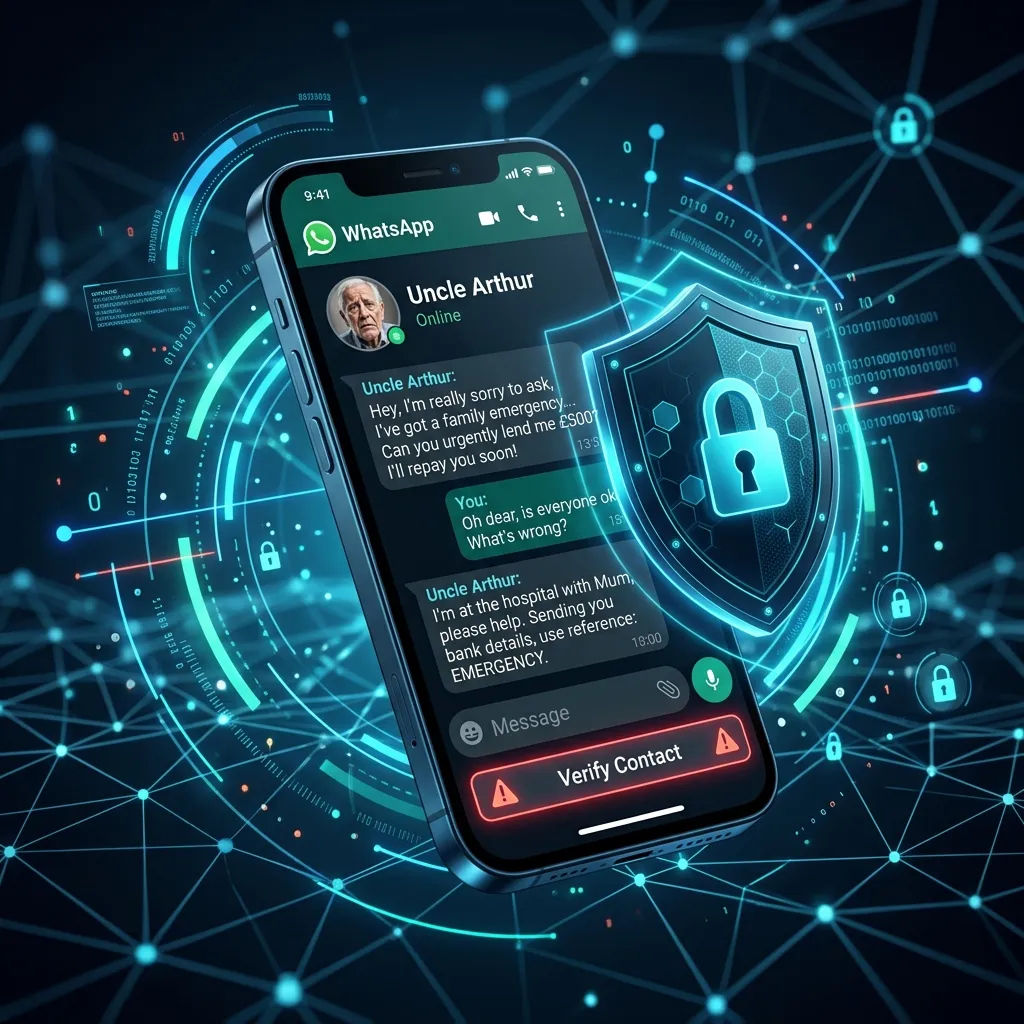
Imagine someone makes a WhatsApp account with your boss's photo and messages you saying, "I am in an urgent meeting, send money to this vendor right now." It looks real, but it's a scammer who stole their photo. Always call your boss on their regular number to verify!
- Fraudsters clone a director's photo and name on WhatsApp, then request urgent, confidential payments from finance staff.
- The scam relies on speed and trust, not hacking — no system is breached.
- One rule stops most attempts: no payment moves without a phone callback to a number already on file.
THREAT INTEL · July 14, 2026 · 7 min read · By Hardik Patel
A finance executive gets a WhatsApp message from the MD's photo and a near-matching number, asking for an urgent, confidential transfer. No call, no email. By the time anyone checks, the money is gone. This is now one of the most common fraud patterns hitting Indian businesses.
Table of Contents - How the Scam Actually Works - Why It Works on Businesses That Are Otherwise Careful - How to Stop It - What iTechFixr Sees in the Field - Key Takeaways - Frequently Asked Questions - How iTechFixr Can Help
How the Scam Actually Works
A fraudster copies a director's WhatsApp display photo and name, messages a finance employee directly, and requests an urgent transfer under a confidentiality excuse — all without touching your systems or accounts.
The pattern runs in a fixed sequence. First, research: the scammer pulls leadership names and roles from LinkedIn, the company website, or public filings — information most businesses publish willingly. Second, setup: a new WhatsApp account is created using the target's real photo, often lifted straight from a public profile, with a display name matching exactly. Third, contact: the fake account messages someone in finance or accounts directly, often opening with "I'm in a meeting, can't call right now." Fourth, pressure: the message introduces urgency — an NDA deal, a vendor deadline, a confidential acquisition — because urgency is the mechanism the whole scam depends on. Fifth, the ask: a bank account is shared, described as a "new vendor account" or "urgent advance," with a request to skip the usual sign-off given the confidentiality.
None of this requires breaching your email server, your accounting software, or your bank. It requires one convincing message and one employee under pressure to decide fast.
Why It Works on Businesses That Are Otherwise Careful
The scam succeeds because WhatsApp has become a default business channel in India, and employees are trained by habit to treat a message from "the boss" as an instruction rather than a request that needs verification.
There's no red flag built into the interface — no padlock icon for a fake profile photo, no warning that a number doesn't match a saved contact. [Likely] Businesses that run tight technical security — firewalls, endpoint protection, email filtering — remain fully exposed to this scam precisely because none of those controls sit anywhere near a WhatsApp conversation. This is a people-and-process gap, not a technology gap, which is exactly why it keeps working even at companies that have invested seriously in IT security elsewhere.
How to Stop It
No payment moves on a chat message alone — every instruction, regardless of who it appears to come from, needs a second-channel confirmation: a phone call to a known number, never the number that just messaged you.
Build this into a short, repeatable checklist for your finance team:
- Treat "urgent + confidential + WhatsApp only" as a red flag, not a compliment to be trusted quickly.
- Verify by phone, using a saved number — not one supplied in the chat itself.
- Check the number digit by digit against your actual leadership contacts before assuming it's genuine.
- Report and block immediately, and warn the rest of the team so the same number isn't tried on someone else in the office.
- Apply dual approval on transfers above a set threshold, so no single person can authorize and execute alone under pressure.
Our related piece on payment verification walks through building this into your actual approval workflow, not just a one-off memory.
What iTechFixr Sees in the Field
Across the vendor-risk and process reviews we run for manufacturing and trading businesses in the Pune-PCMC belt, WhatsApp impersonation attempts are consistently the most common fraud pattern flagged by finance staff during our Human Firewall Workshops — more frequent than email-based phishing in this specific client segment.
Hardik Patel, CEH-certified cybersecurity trainer and founder of iTechFixr Infotech LLP, Pimpri-Chinchwad, notes that the businesses most exposed are rarely the ones with weak IT — they're the ones where a director's verbal or chat-based go-ahead has always been enough to move money, because that informality is efficient right up until someone impersonates it.
Key Takeaways
- WhatsApp impersonation scams clone a leader's photo and name — they don't require any system breach.
- Urgency and confidentiality framing exist specifically to prevent verification, not because the request is genuinely sensitive.
- A callback rule to a saved number, applied without exception, defeats the majority of these attempts.
- This is a process gap, not a technology gap — no firewall or antivirus stops it.
Frequently Asked Questions
Q: Can a WhatsApp account really use someone else's photo and name?
A: Yes. WhatsApp does not verify a display photo or name against any real identity — anyone can set both to match a real person, which is exactly what makes this scam effective against employees who trust what they see on screen.
Q: What should an employee do if they get an urgent payment request over WhatsApp?
A: Stop, don't reply with any confirmation, and call the person on a number you already have saved — never one provided in the chat — before taking any action on the request.
Q: Is this the same as a "boss scam" or "CEO fraud"?
A: It's closely related. WhatsApp impersonation is one common delivery method for the broader CEO/CFO impersonation pattern — see our detailed breakdown of how boss scams actually work for the full sequence.
Q: Can this happen even if our company WhatsApp accounts are secure?
A: Yes — the fraudster isn't using your company's account at all. They create an entirely new account with a copied photo and name, so your own account security has no bearing on whether this scam can be attempted against your staff.
How iTechFixr Can Help
Need a compliance-ready risk framework? Let's map your gaps together. iTechFixr helps businesses determine their exact obligation status and builds the detection-to-reporting pipeline needed to genuinely protect your operations.